Why does my knee hurt?
The knee carries your full body weight with every step, so it is one of the joints most often affected by wear, injury and inflammation. In Tindivanam and nearby villages we see knee pain in farmers, homemakers who squat for daily work, two-wheeler riders, students who play sports and elders with long-standing arthritis.
Common causes of knee pain
- Osteoarthritis: gradual wearing of the cartilage cushion, most common after 45 and in people who are overweight
- Ligament injuries: ACL, PCL or MCL tears from a twist, fall or sports injury
- Meniscus tear: damage to the shock-absorbing cartilage, often with locking or clicking
- Patellofemoral pain: pain around the kneecap, common in young people and runners
- Rheumatoid arthritis and gout: inflammation that causes swelling, warmth and stiffness
- Old fractures or injuries that did not heal in the right position
Symptoms you should not ignore
- Pain on climbing stairs, squatting or sitting cross-legged
- Morning stiffness or stiffness after sitting
- Swelling, warmth or a feeling of fluid in the knee
- Clicking, locking or the knee “giving way”
- Bowing of the legs or difficulty straightening the knee
- Pain that disturbs your sleep
How we diagnose knee problems
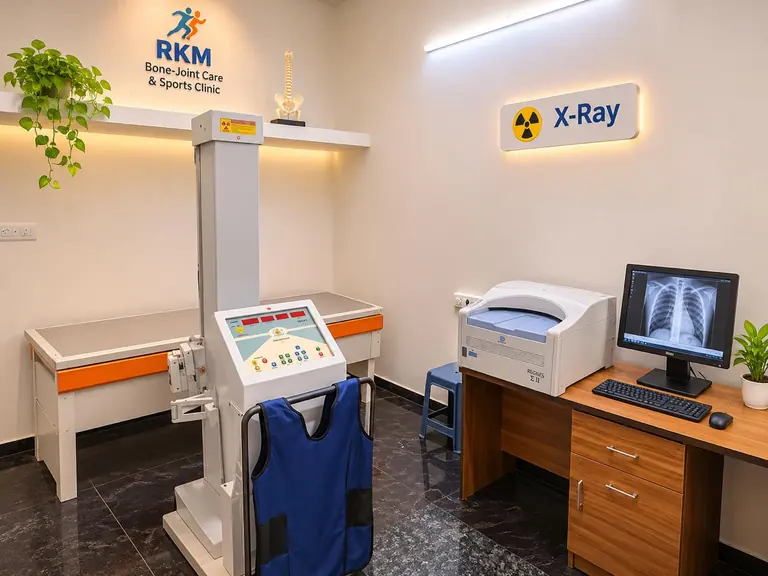
Your visit starts with a detailed conversation and physical examination of the knee, hip and walking pattern. An X-ray shows the joint space and bone changes. An MRI is suggested only when a ligament or meniscus injury is suspected, and blood tests when inflammatory arthritis is a possibility. You get a clear explanation of what is happening inside your knee.
Knee pain treatment options
Treatment is planned step by step, starting with the simplest option that can work for you:
- Lifestyle changes: weight control, footwear and avoiding positions that strain the knee
- Medicines for pain and inflammation, used safely and for the right duration
- Physiotherapy to strengthen the thigh muscles that protect the knee
- Knee braces and supports for stability during activity
- Joint injections (steroid, hyaluronic acid or PRP) in selected patients
- Arthroscopy (keyhole surgery) for meniscus and ligament problems
- Total or partial knee replacement for advanced arthritis
Knee replacement surgery in Tindivanam
Knee replacement is considered when arthritis has badly damaged the joint and pain continues despite medicines, exercises and injections. The worn joint surfaces are replaced with smooth artificial parts. Most patients start walking with support within a day or two after surgery and return to daily activities over the following weeks with regular physiotherapy. The doctor will tell you whether you need a replacement, which type suits you and what recovery will look like.
Consult Dr. Rajkumar Ekambaram
Dr. Rajkumar Ekambaram (M.S. (Orthopaedics), FIJR (Shalby), FASM (ISAKOS), DSM (USA)), Consultant Orthopaedic Surgeon and Associate Professor & Chief at JR Medical College, Tindivanam, personally examines every patient at RKM Bone-Joint Care & Sports Clinic, explains the findings in simple language and plans treatment that suits your age, work and goals. He trained in joint replacement at Shalby Hospital, Ahmedabad under Dr. Vikram Shah and performs total knee replacement (TKR), partial knee replacement (UKR), complex and revision knee replacement and high tibial osteotomy (HTO), with joint preservation whenever the knee can be saved.
Frequently asked questions
How much does knee replacement cost in Tindivanam?
Can knee pain be cured without surgery?
Which exercises are good for knee pain?
Is walking good for knee arthritis?
This page is for general information. Every patient is different, so please consult the doctor for diagnosis and treatment advice.